Nepal Driving License Written Exam (Likhit) 2026: Questions, Pass Mark & Free Mock Test
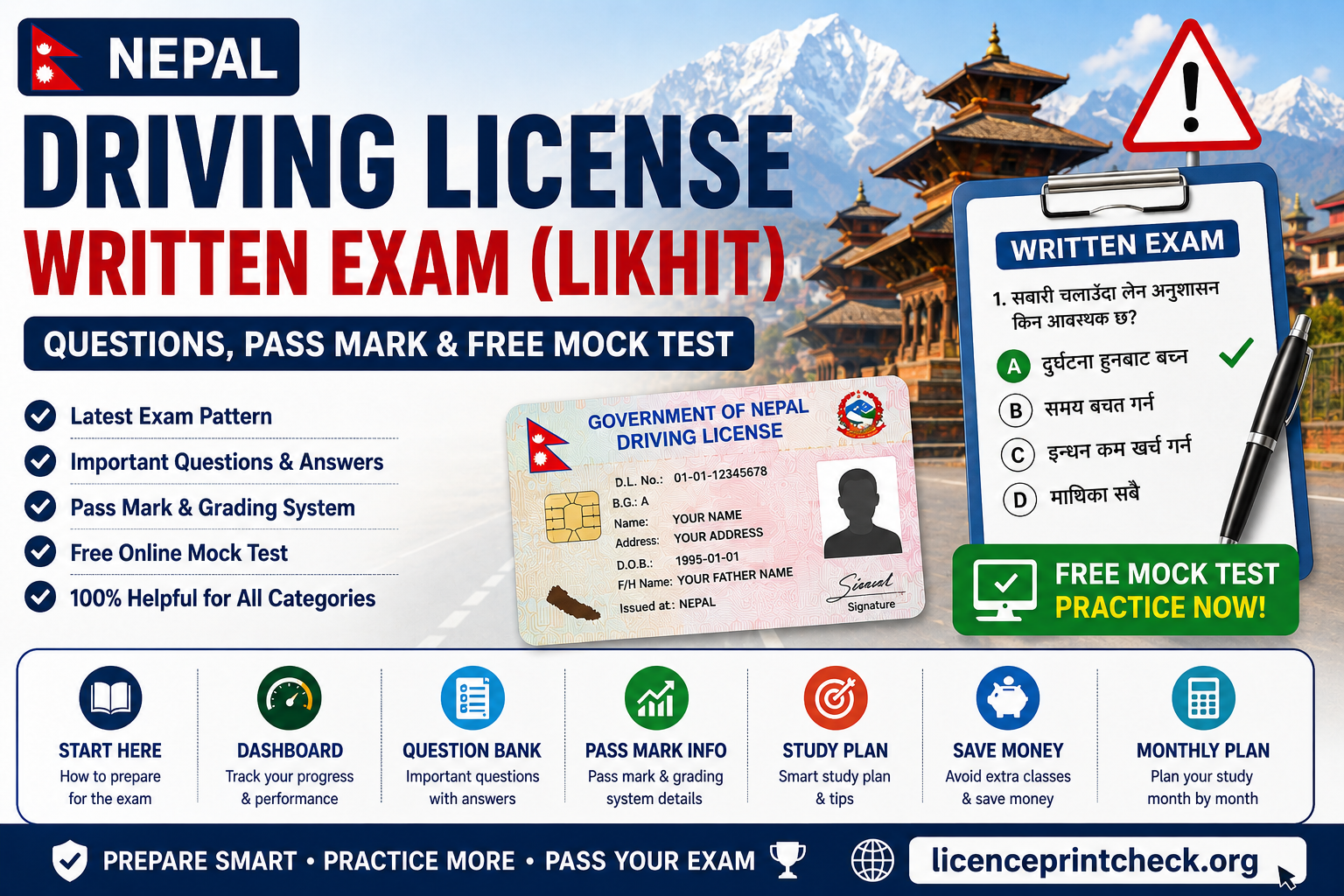
The Nepal driving license written exam, known as the Likhit, is the first test you must clear before your trial, and most people fail it only because they walk in unprepared. This 2026 guide gives you the exact format, the pass mark, the topics with their real weight, sample questions from the DOTM bank, and a free interactive mock test you can take right now.
Table of Contents
Likhit Exam Format & Pass Mark
The Likhit is a computer-based multiple-choice test taken at your DOTM office. Every question is drawn from the official national question bank, so what you study is exactly what you are tested on.
You need 60% to pass, which is 15 correct answers out of 25. Questions are pulled from a national DOTM bank of around 500 questions, each has four options, and some show a traffic-sign image. You pick Nepali or English at the terminal, and the questions are identical in both. Phones are not allowed inside the exam room, so leave yours with the staff before you start.
Topics Covered (and Their Weight)
All 25 questions are spread across six categories. Knowing the weight tells you where to spend your study time, road rules and traffic signs alone make up nearly half the paper.
Traffic Signs & Signals
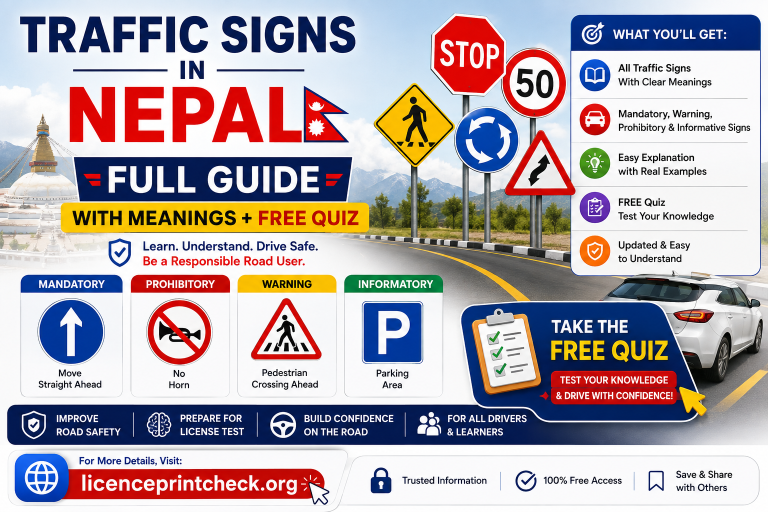
Learn all three sign families, mandatory (blue/red circles), cautionary (red triangles), and informational (blue rectangles). Expect a sign image with four names to choose from, plus signal questions like the flashing amber light.
Traffic Rules & Road Laws
The biggest category. Focus on right-of-way, speed limits by zone (20 km/h near schools, 40 in residential areas, 80 on highways), overtaking rules, and pedestrian priority at zebra crossings.
Vehicle Knowledge
Covers pre-drive checks, dashboard warning lights, horn restrictions near hospitals and schools, and when a vehicle is not roadworthy, for example a broken brake light.
First Aid & Emergencies
Counter-intuitive but heavily tested: secure the scene and call for help first, do not move an injured person unless they are in immediate danger, and never give food or water to a casualty.
Sample Questions with Answers
These are real questions from the DOTM bank, with the correct answer marked. Read the logic behind each one, that is what the exam tests.
- The vehicle going straight
- The vehicle coming from the right
- The larger vehicle
- The vehicle that arrived first
- Reduce speed ahead
- No motor vehicles allowed
- Parking prohibited
- Road ends ahead
- 0.03% (30 mg per 100 ml)
- 0.05% (50 mg per 100 ml)
- 0.08% (80 mg per 100 ml)
- Any detectable amount is illegal
- Immediately move the person to the side
- Secure the scene and call for emergency help
- Give the person water to drink
- Leave to find a hospital
- Vehicles entering the roundabout
- Vehicles already in the roundabout
- The larger vehicle
- Whoever sounds the horn first
- Overtaking is allowed if the road is clear
- No overtaking from either direction
- Parking is allowed on both sides
- The road ahead is one-way
Speed Limits & Fines Worth Memorising
A handful of numbers show up in almost every paper. Lock these speed limits and common fines into memory and you have several easy marks in the bag before you even sit down.
Speed Limits
- School zones 30 km/h
- Residential areas 40 km/h
- City / urban roads 40–50 km/h
- Highways 80 km/h
Common Fines
- No seatbelt Rs 1,000
- No helmet (two-wheeler) Rs 1,500
- Phone while driving Rs 1,500
- Running a red light Rs 1,000
- Speeding Rs 1,500–3,000
- Drink driving Rs 10,000–15,000
Overtaking questions almost always hinge on the lane markings: a single broken yellow line lets you overtake when the road is clear, while a double solid yellow line means no overtaking from either side. Always overtake on the right and pull back to the left as soon as you are past.
Free Practice Mock Test (Interactive)
Answer these five real questions, then tap the button to see your score. Pass mark here is 3 out of 5, the same 60% you need in the real Likhit.
How to Prepare in 3 Days
You do not need weeks. A focused three-day plan, ending with full mock tests, is enough for most people to pass first try.
Signs & Road Rules
The two biggest categories. Memorise sign families and speed limits by zone (20 school, 40 residential, 80 highway), and drill right-of-way and pedestrian priority.
Acts, Technical & Environment
Learn the age limit (18 for a car), the 0.03% BAC limit, penalties, pre-drive checks, dashboard lights, and horn restrictions near hospitals and schools.
First Aid + Full Mocks
Cover accident protocols, then take three or four full 25-question mock tests. Retest only the questions you miss and aim for 20+ correct before exam day.
Already cleared your trial? Your smart card now goes to central printing. Track exactly where it is in seconds.
Track Your LicenceWhat If You Fail?
Failing is not the end, there is no limit on attempts, but the system enforces a cooling-off period before you can rebook.
Wait 15 days before you can retake. The DOTM online portal blocks rebooking before that date, and visiting the office in person will not bypass it.
Rebook online at applydlnew.dotm.gov.np once the window closes, and pay the retest fee (around NPR 400) to reschedule.
No attempt limit. Identify which category tripped you up and practise that section hard before the next try.
Frequently Asked Questions
Can I take the Likhit exam in English?
Yes. At the DOTM terminal you select your language at the start, and both Nepali and English are available. The questions are identical in both languages.
How soon can I take the trial test after passing the Likhit?
The trial is usually booked through the DOTM portal once your Likhit pass result is out. In Kathmandu offices the wait for a trial slot is typically 1 to 3 weeks, depending on the schedule.
Do all the questions come from traffic signs?
No. The 25 questions are spread across all six categories. Traffic signs are about 4 to 5 questions, while road rules and right-of-way carry the most, around 6 to 8.
Is the question bank the same everywhere in Nepal?
Yes. It is a single national DOTM bank of around 500 questions, and every office across all 77 districts draws from the same set.
Can I use my phone during the exam?
No. Phones are not permitted in the exam room. You leave your phone with the staff or in a designated area before entering the terminal, and this is strictly enforced.
What should I bring on exam day?
Bring your DOTM application printout with the exam appointment confirmation, your original citizenship or passport, and a medical fitness certificate if your category requires one.
Conclusion
The Likhit is 25 questions in 30 minutes, and you pass with 15 correct. Spend most of your time on road rules and traffic signs since they carry the most marks, learn the counter-intuitive first-aid answers, and take a few full mock tests until you consistently score 20 or more. Do that, and you clear it first try, then it is straight on to your trial.